




West Brom ban criticised by Simon Jordan after Nottingham Forest controversy.
 September 10, 2026
Simon Jordan Questions West Brom Striker Aune Heggebo’s Two-Match Ban After Nottingham Forest Handball Controversy
West Bromwich Albion may have enjoyed a highly encouraging beginning to their 2026/27 Championship campaign, but one decision from the opening weekend continues to leave a bitter taste among supporters.
The main source of frustration has been the two-match suspension handed to striker Aune Heggebo by the Football Association following West Brom’s 2-1 victory over Norwich City at Carrow Road. The Norwegian was punished after his arm was involved in the club’s opening goal, despite the incident initially going unnoticed by both the referee and assistant referee.
Although West Brom managed to overcome Heggebo’s absence during their Carabao Cup trip to Newcastle United and their subsequent Championship meeting with Burnley, his qualities were clearly missed. The striker provides a physical presence, stretches opposition defences and creates additional room for his teammates to exploit. His absence therefore reduced one of the important dimensions of West Brom’s attacking play.
West Brom’s first five Championship results of the 2026/27 season were:
Norwich City (A): 2-1 win
Burnley (H): 3-1 win
Middlesbrough (A): 3-1 defeat
Charlton Athletic (H): 1-1 draw
Watford (H): 1-0 win
With Heggebo’s suspension now completed, West Brom can move forward. However, many supporters still believe the club was treated unfairly and that the striker was effectively punished for an officiating error that occurred during the match.
The controversy has become even more significant following a similar handball incident involving Nottingham Forest defender Neco Williams against Tottenham Hotspur. The comparison has prompted questions about whether the FA has established an appropriate and consistent standard for imposing retrospective two-match suspensions.
TalkSPORT pundit Simon Jordan has now offered his assessment of the situation, arguing that the FA should be extremely cautious when attempting to determine a player’s intention in such circumstances.
How Aune Heggebo was punished after Norwich handball
The controversy began with West Brom’s opening goal against Norwich.
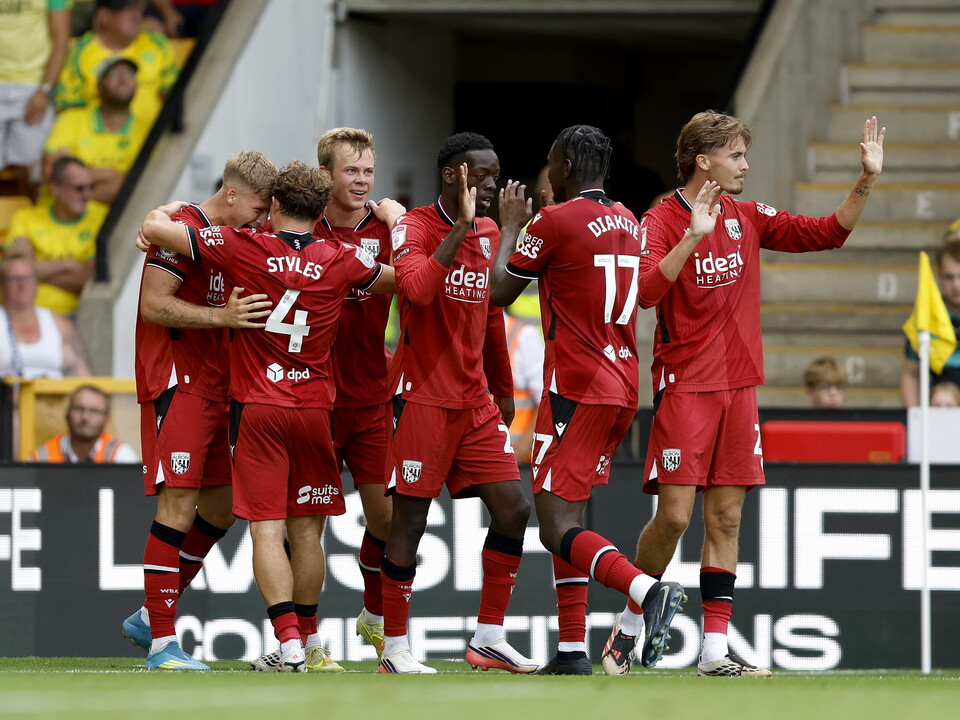
Jimmy-Jay Morgan delivered a dangerous cross into the penalty area, with Heggebo attempting to get on the end of it. The ball made contact with the Norwegian’s arm before finding the back of the net.
Neither referee Tim Robinson nor the assistant referee on the far side detected the handball at the time. The goal was therefore allowed to stand, giving West Brom an early advantage.
The incident subsequently attracted considerable attention, particularly because there was no VAR available in the Championship. The controversy once again fuelled discussions over whether the technology should eventually be introduced into England’s second tier.
However, the situation went further than simply debating the validity of the goal.
At the beginning of the following week, Heggebo was informed that he had been charged with breaching FA Rule E3.1. The charge was understood to be the first of its kind in English football following a change to the regulations before the 2024/25 campaign.
The FA claimed that Heggebo had successfully deceived a match official by handling the ball in a direct and successful attempt to score a goal.
West Brom immediately appealed the decision.
The club argued that the ball had taken a deflection from the Norwich goalkeeper immediately before making contact with Heggebo’s arm. As a result, West Brom maintained that the striker had less than a tenth of a second to react to the ball’s altered trajectory, making it difficult to argue that he deliberately handled it to deceive the officials.
Despite the appeal, the FA rejected West Brom’s argument and upheld the charge.
Heggebo was consequently forced to miss West Brom’s fixtures against Newcastle United and Burnley.
Neco Williams incident raises further questions
The debate surrounding Heggebo’s punishment returned to the spotlight following another controversial handball in the Premier League.
Nottingham Forest faced Tottenham Hotspur in a match that ultimately ended in a goalless draw. During the second half, Forest appeared to have taken the lead when Neco Williams attempted to help Morgan Gibbs-White’s chipped effort over the goal line.
The situation developed after some poor defending from Tottenham, with Williams positioned just inches from the line.
As he attempted to head the ball into the net, the ball instead struck his right hand before crossing the line. Unlike the West Brom-Norwich incident, VAR was available and immediately reviewed the situation.
The goal was subsequently disallowed.
Forest players had initially celebrated, just as West Brom had done at Carrow Road. That naturally led to comparisons between the two incidents, particularly over whether Williams had intentionally attempted to deceive the officials by using his hand.
The key difference, however, was that VAR intervened immediately in the Forest match, preventing the goal from standing.
Simon Jordan disagrees with Heggebo suspension
Speaking on TalkSPORT, Simon Jordan questioned whether Heggebo should ever have received a two-match suspension.
Jordan acknowledged that the evidence surrounding Heggebo’s incident appeared stronger than the evidence against Williams. Nevertheless, he argued that the FA’s decision creates a difficult problem because it requires authorities to determine what was going through a player’s mind at the exact moment an incident occurred.
According to Jordan, judging a player’s intention or motivation without knowing exactly what they were thinking is an extremely dangerous path for football authorities to take.
He explained that once disciplinary decisions begin relying heavily on assumptions about a player’s intentions, officials are effectively attempting to determine a person’s motivation without having direct knowledge of their thoughts or character.
Jordan also pointed out an important distinction between the two incidents. The West Brom goal was allowed to stand and subsequently became the subject of retrospective disciplinary action, whereas Williams’ goal was immediately ruled out following VAR intervention.
When presenter Jim White later asked Jordan directly whether he believed Heggebo should have been banned, the pundit was unequivocal in his response.
“No,” Jordan replied, reiterating that determining someone’s intention or motivation is extremely difficult and effectively involves attempting to look into their mind.
Has the FA created a difficult precedent?
For West Brom supporters, the bigger concern is what the Heggebo decision could mean for future incidents.
The FA has effectively established that a player can face retrospective punishment when authorities believe he deliberately handled the ball in an attempt to deceive a match official and successfully score a goal.
That could potentially create significant problems whenever another controversial incident occurs.
Williams is unlikely to face a similar punishment because VAR intervened and the goal was disallowed during the match. Nevertheless, it raises an interesting hypothetical question: would the FA have taken the same action against him had the incident occurred in the Championship, where VAR was unavailable?
There has already been another incident in the second tier that West Brom supporters could point towards.
During Albion’s meeting with Middlesbrough, Will Lankshear appeared to be in an offside position when Boro scored their opening goal. The assistant referee failed to flag for offside, allowing Lankshear to continue his run, score and celebrate.
From West Brom’s perspective, that incident could be viewed as another example of a player benefiting from an officiating error. Following the precedent established by the Heggebo case, supporters could reasonably question whether Lankshear should also have faced retrospective punishment for allegedly benefiting from the officials’ failure to identify the infringement.
That is where the FA’s decision becomes particularly controversial.
VAR debate intensifies in the Championship
The Heggebo case could therefore have consequences beyond one player and one match.
Every controversial incident in the Championship could now potentially lead to discussions about whether the player involved should receive a retrospective suspension. Rather than resolving controversial moments, the FA’s decision could arguably create another layer of uncertainty and debate.
It has also strengthened the argument for introducing VAR into the Championship.
Many Championship supporters remain opposed to VAR because they fear that the technology could reduce the spontaneity, emotion and fast-paced nature that makes the competition so popular. The second tier has traditionally been associated with passionate crowds, dramatic moments and celebrations that are sometimes followed by controversy.
However, the absence of VAR also means that significant refereeing mistakes can go uncorrected during matches.
The Heggebo case has effectively added another dimension to that debate. Instead of correcting the mistake during the game, the FA reviewed the incident afterwards and imposed a suspension on the player.
For some observers, that raises the question of whether the authorities are effectively creating a form of retrospective VAR through disciplinary action.
The FA may ultimately come to regret the decision to punish Heggebo if similar incidents continue to occur. Every controversial handball or disputed goal in the Championship could now bring the Norwegian striker’s case back into the conversation.
For West Brom, however, the immediate priority will be putting the controversy behind them and concentrating on their Championship campaign. Heggebo’s return should provide a welcome boost to the Baggies, while the debate over whether his suspension was justified is likely to continue for some time.