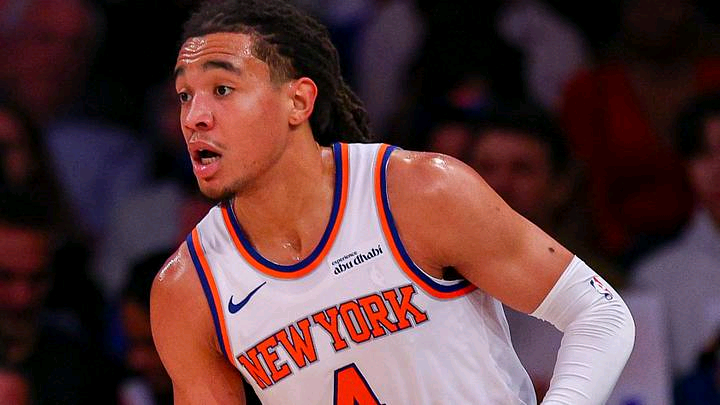
Knicks Already Know the Price of Trading Pacome Dadiet to Open Up a Roster Spot
Other NBA teams have given the New York Knicks a clearer idea of the assets they may need to attach to Pacome Dadiet’s contract to move him off the roster.
The New York Knicks may have to part ways with young small forward Pacome Dadiet if they intend to sign two veteran players from their training-camp invitation list. Interestingly, a recent transaction involving the Sacramento Kings could provide the Knicks with a useful indication of what it might take to move Dadiet’s contract. Based on similar deals around the league, New York might need to surrender a second-round draft pick to complete the transaction. Alternatively, the team could potentially get the deal done by offering cash compensation alone.
As Jeremy Cohen of Knicks Film School highlighted, the Sacramento Kings sent a 2033 second-round draft pick to the Atlanta Hawks during the offseason to persuade Atlanta to take on Devin Carter’s $4.9 million salary. That transaction offers a useful point of comparison for the Knicks as they consider their options regarding Dadiet.
Unlike Carter, whose salary was considerably higher, Dadiet is scheduled to earn approximately $2.9 million. Since his contract represents a smaller financial commitment, the Knicks may not need to offer as much compensation to convince another team to absorb his salary. This could make the process of moving him off the roster considerably easier for New York.
Although Carter entered the league with the reputation of a lottery pick, having been selected in the same draft class as Dadiet, his draft status did not ultimately prevent Sacramento from attaching a second-round pick to his contract to facilitate his departure. The Hawks did not appear to view Carter as a player whose potential justified keeping him on the roster, as they eventually waived him. Carter has since found another opportunity with the Boston Celtics.
Given that Dadiet’s salary is lower than Carter’s, it is reasonable to believe that the Knicks could find a team willing to take on his contract for a smaller price. Rather than surrendering a draft pick, New York might be able to complete the transaction by offering cash.
Cohen also pointed to another recent example that supports this possibility. Last September, the Atlanta Hawks reportedly sent cash to the Brooklyn Nets in exchange for Brooklyn agreeing to absorb Kobe Bufkin’s $4.5 million salary. As with Carter, the transaction did not result in the receiving team retaining the player for the long term. The Nets ultimately waived Bufkin as well.
These transactions demonstrate that NBA teams sometimes need to provide additional financial or draft compensation when attempting to move players whose contracts they no longer wish to carry. However, the amount of compensation required can vary depending on the player’s salary, the receiving team’s circumstances, and the overall structure of the deal.
The Knicks Have Enough Assets to Move Pacome Dadiet
Whether the Knicks ultimately need to offer cash or surrender a second-round draft pick, they appear to have the resources necessary to facilitate Dadiet’s departure. New York’s front office acquired several additional second-round picks on draft night, giving the organization more flexibility when negotiating trades.
The Knicks also finished the 2025–26 season with approximately $6.6 million more in cash received than they sent out. That financial position could provide another avenue for completing a salary-clearing transaction if the front office decides that moving Dadiet is necessary to create room for additional signings.
Consequently, the primary obstacle may not be the Knicks’ ability to pay the price. Instead, identifying a suitable trade partner could prove more difficult, particularly at this stage of the offseason.
Many NBA teams have already used much of their available roster and financial flexibility. Some organizations may be reluctant to take on another player’s salary, while others may prefer to wait before making additional personnel decisions. These circumstances could narrow the pool of teams willing to negotiate with New York.
Nevertheless, Dadiet’s relatively modest $2.9 million salary should make his contract more manageable than those of players carrying significantly larger financial commitments. There may still be several teams capable of absorbing the contract if the Knicks are willing to provide the appropriate compensation.
The key will be finding an organization that has sufficient roster flexibility and sees enough benefit in the proposed transaction to agree to the deal.
Why Timing Could Be Crucial for New York
If the Knicks are serious about moving Dadiet to accommodate additional veteran signings, completing the transaction before NBA rosters are finalized could be the most practical approach.
Under the roster rules described in the report, teams can carry as many as 21 players through October 19. Once that deadline passes, the maximum roster size returns to 15 players. This distinction could significantly affect the number of teams available to participate in a trade.
Before the deadline, a team may have greater flexibility to absorb a player temporarily while making its final roster decisions. Afterward, organizations will have to comply with the reduced roster limit, meaning that some teams may no longer have the space necessary to take on an additional player.
Trading Dadiet after the deadline would not necessarily be impossible. NBA teams can still complete transactions under the applicable roster rules, provided they meet the relevant requirements. However, the reduction in available roster spots could make it more challenging for the Knicks to identify a willing partner.
For that reason, acting sooner rather than later could give New York a better opportunity to negotiate a favorable deal. The front office would have more time to explore potential trade partners and determine whether cash or a draft pick would be sufficient to complete the transaction.
The Real Question Is Whether the Knicks Will Make the Move
Ultimately, the Knicks’ situation appears to be less about whether Pacome Dadiet can be traded and more about whether the organization is prepared to move him to create additional roster space.
Recent transactions involving Devin Carter and Kobe Bufkin provide examples of how NBA teams have handled similar salary-clearing situations. Those deals suggest that New York may not need to offer substantial compensation to move Dadiet, especially considering that his $2.9 million contract is smaller than the salaries involved in the previous transactions.
With additional second-round draft picks and cash resources available, the Knicks appear to have several possible ways to facilitate a deal. The final cost will depend on the team willing to acquire the contract and the terms required to make the transaction worthwhile.
If the Knicks believe that signing two veteran players would strengthen their roster, moving Dadiet could become a necessary step toward accomplishing that goal. However, the decision will depend on the front office’s assessment of his future value, the benefits of adding veteran players, and the availability of suitable trade partners.
The bottom line is that the Knicks appear to have a workable path to moving Dadiet’s contract. They may need to part with a second-round pick, or they could potentially get the job done with cash alone. The bigger question is whether New York will act before roster limits tighten and commit to making the necessary changes to accommodate another veteran signing.