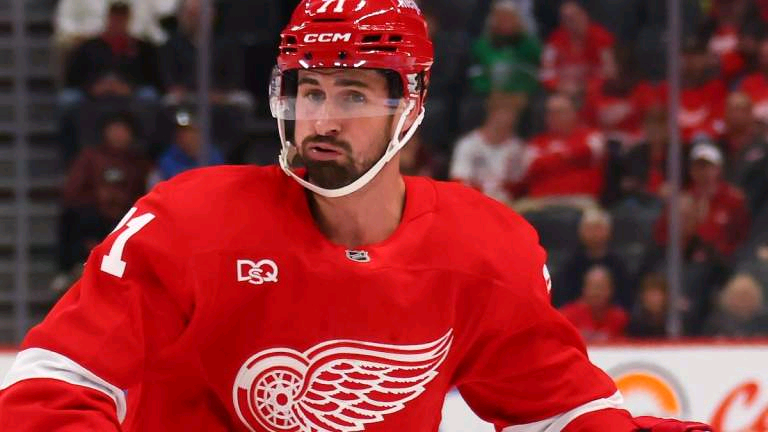
Red Wings Trade Proposal Sends Dylan Larkin to the New Jersey Devils in Exchange for a Six-Player Blockbuster Package Built Around Jack Hughes
The Detroit Red Wings finally managed to secure a much-needed victory on Thursday, defeating the Philadelphia Flyers by a narrow 2–1 margin. The win marked only Detroit’s second victory of the season, leaving the team with a disappointing record of two wins and five losses. Although the result provided some temporary relief, the Red Wings continue to face several significant challenges as they attempt to improve their performance and establish a more competitive roster. One of the most pressing issues involves the uncertain future of former team captain Dylan Larkin, whose reported desire to leave Detroit has created considerable speculation about the organization’s next move. However, a new trade proposal published on Friday has introduced a potential solution that could fundamentally change the direction of the franchise.
According to a hypothetical trade scenario published by PuckGM, a website dedicated to roster construction and trade proposals, the Red Wings could pursue a major roster overhaul by sending Larkin to the New Jersey Devils in exchange for a substantial package of players. The proposed return would be headlined by Jack Hughes, the talented American center who has established himself as one of the NHL’s most dynamic offensive players. The deal would also include Hughes’ younger brother, defenseman Luke Hughes, and forward Stefan Noesen. In return, New Jersey would receive Larkin, defenseman Simon Edvinsson, forward Marco Kasper, and Detroit’s 2027 first-round draft pick.
Such a transaction would represent a dramatic change for both organizations. Detroit would have the opportunity to acquire high-level offensive talent and strengthen its immediate competitiveness, while New Jersey would add an experienced, established center in Larkin, along with a promising young defenseman, a developing forward, and a valuable future draft selection.
Nevertheless, the proposed deal raises important questions about whether either team would be willing to sacrifice so much talent, particularly given the importance of the players involved.
Dylan Larkin’s Trade Request and the Potential Deal
Dylan Larkin’s future in Detroit has become a major topic of discussion following reports that he requested a trade in June. Despite the reported request, the 30-year-old center remains with the Red Wings as the situation continues without a publicly confirmed resolution.
The hypothetical proposal would give Detroit an opportunity to end the uncertainty surrounding Larkin while acquiring several players who could contribute to the team’s long-term development. However, the potential departure of Simon Edvinsson could prove especially difficult for the organization to accept.
Detroit’s interim general manager, Shawn Horcoff, reportedly made his position clear earlier in the week, stating that he had “zero interest” in trading Edvinsson. His comments suggest that the young defenseman remains an important part of the franchise’s plans, making his inclusion in the proposed package a significant obstacle.
The central question, therefore, is whether the opportunity to acquire Jack Hughes and his brother Luke would be valuable enough to persuade Detroit’s management to reconsider its position.
Dylan Larkin’s Career and Contract Situation
Larkin, who was born on July 30, 1996, in Waterford, Michigan, has spent his entire 11-season NHL career with the Detroit Red Wings. Selected 15th overall in the 2014 NHL Draft, he has developed into one of the franchise’s most recognizable players and has accumulated considerable experience as a center.
According to NHL.com columnist Nicholas J. Cotsonika, Larkin ranks 10th in Red Wings franchise history with 643 career points, consisting of 276 goals and 367 assists across 808 games. Despite those achievements and his importance to the organization, his postseason experience has been limited. He has not appeared in the Stanley Cup playoffs since his rookie season, a disappointing reality for a player who has spent more than a decade with the franchise.
The trade situation became more complicated on June 27, when former general manager Steve Yzerman confirmed that Larkin’s agent had requested a trade. Following that development, Larkin also lost the captaincy he had held for six seasons, marking another major change in his relationship with the organization.
Even with those developments, Larkin has continued to play for Detroit while his future remains uncertain. His current eight-year contract is worth $69.6 million and extends through the 2030–31 season, giving the team a substantial financial commitment to consider if it decides to move him.
A trade could provide both sides with a fresh start. Detroit would have the opportunity to reshape its roster around younger or different talent, while Larkin could join a team with ambitions of competing at a higher level. However, any transaction would need to account for his long-term contract and the value he continues to provide as an established NHL center.
Jack Hughes: The Offensive Star at the Center of the Proposal
Jack Hughes would be the most prominent player involved in the proposed trade and the principal reason Detroit might consider such a significant roster change.
Born on May 14, 2001, Hughes was selected first overall by New Jersey in the 2019 NHL Draft. At 25 years old, he has already established himself as a highly productive offensive player, recording 437 points in 436 career games. His accomplishments include a particularly impressive 99-point campaign during the 2022–23 season, demonstrating his ability to produce at an elite level.
Hughes is signed to an eight-year, $64 million contract extension that runs through 2030. His age, offensive ability, and long-term contractual security would make him an attractive addition for Detroit, especially if the organization wants to improve immediately rather than undertake a lengthy rebuilding process.
Acquiring Hughes would give the Red Wings a new offensive centerpiece and potentially provide the foundation for a more dangerous forward group. His playmaking ability and scoring production could help Detroit become more competitive, although his arrival alone would not necessarily resolve all the team’s existing weaknesses.
The greatest difficulty is that Hughes is also one of New Jersey’s most important players. There is no indication in the information provided that the Devils are actively considering trading him. Consequently, the proposal remains a speculative exercise rather than evidence of an actual negotiation between the two teams.
Luke Hughes Would Add Further Value to Detroit’s Defense
The proposed package also includes Luke Hughes, Jack’s younger brother, who could become an important component of Detroit’s defensive group.
Luke Hughes, 23, was selected fourth overall in the 2021 NHL Draft after spending two seasons playing college hockey at the University of Michigan. His background in Michigan hockey could make a move to Detroit an especially interesting possibility, although that connection alone would not determine whether the trade would make sense.
In October 2025, Luke signed a seven-year contract worth $63 million, carrying an annual salary-cap hit of $9 million. That agreement would provide Detroit with a relatively long period of contractual control over a young defenseman who could continue developing into a key contributor.
From the Red Wings’ perspective, acquiring both Hughes brothers would represent a significant opportunity to add young, high-profile talent at two important positions. Jack would strengthen the forward group, while Luke could help reinforce the blue line.
However, securing both players would require Detroit to surrender substantial assets. In addition to Larkin, the proposed return to New Jersey would include Edvinsson, Kasper, and a first-round selection in 2027. That cost would need to be weighed against the benefits of acquiring two established young players with long-term contracts.
Simon Edvinsson’s Inclusion Could Be the Biggest Obstacle
Simon Edvinsson is arguably the most controversial player included in the proposed trade from Detroit’s perspective.
The 23-year-old Swedish defenseman stands 6 feet 6 inches tall and was selected sixth overall in the 2021 NHL Draft. He has recorded 60 points in 175 NHL games, providing evidence of his potential to become an important part of Detroit’s defensive structure.
Edvinsson’s size, age, and development potential make him a valuable asset for a franchise attempting to build a competitive roster. Moving him would mean surrendering a young defenseman who could contribute for years, rather than simply exchanging an established veteran for another player at a similar stage of his career.
His contractual situation also adds urgency. Edvinsson remains an unsigned restricted free agent, and Detroit must sign him by December 1 or he will sit out the season, according to the details outlined in the proposal.
Although the lack of a completed contract creates an immediate challenge for the Red Wings, it does not necessarily mean that the organization would be willing to trade him.
Interim general manager Shawn Horcoff has emphasized Edvinsson’s value. According to The Hockey News reporter Michael Whitaker, Horcoff described the defenseman by saying, “Simon is someone that’s very hard to come by.”
That statement highlights the difficulty Detroit could face in replacing Edvinsson if it decided to include him in a blockbuster transaction. Young defensemen with his combination of size and potential can be important building blocks, and surrendering one could weaken the team’s future defensive depth.
For that reason, even the possibility of acquiring Jack and Luke Hughes might not be enough to convince Detroit to part with Edvinsson. Much would depend on the organization’s assessment of its current roster, its long-term objectives, and the likelihood of signing him to a new contract.
Marco Kasper and Stefan Noesen Complete the Proposed Exchange
The remaining players in the hypothetical deal would provide additional value to both organizations, although their roles and potential contributions differ considerably.
Marco Kasper, a 22-year-old Austrian center, was selected eighth overall in the 2022 NHL Draft. He showed promise during the 2024–25 season, recording 37 points in 77 games. However, his production subsequently declined to 19 points in 81 games, raising questions about his offensive development and consistency.
Kasper is in the final year of his entry-level contract, which carries a salary-cap hit of approximately $886,666. His age, draft pedigree, and experience as a young center could make him an appealing acquisition for New Jersey, particularly if the Devils want to strengthen their depth and add a player who still has room to develop.
Although his recent production has fallen, it would be premature to conclude that his development has reached its ceiling. A change of environment could offer him a different opportunity, while New Jersey could benefit from having another young forward in its system.
Stefan Noesen would move in the opposite direction, joining Detroit as part of the proposed return. The 33-year-old forward was selected 21st overall in the 2011 NHL Draft and is originally from Plano, Texas.
Noesen produced a career-high 41 points with New Jersey during the 2024–25 season, demonstrating that he can provide useful offensive support. His inclusion could give Detroit an additional experienced forward, complementing the more prominent acquisition of Jack Hughes.
Compared with the other players involved, Noesen would be less central to the long-term implications of the deal. Nevertheless, his recent production suggests that he could contribute to the Red Wings’ forward depth while the organization evaluates its broader roster plans.
The New Jersey Devils Would Face a Difficult Decision
From New Jersey’s perspective, the proposed transaction would be far from straightforward. The Devils would acquire Larkin, Edvinsson, Kasper, and Detroit’s 2027 first-round pick, but they would lose Jack Hughes, Luke Hughes, and Stefan Noesen.
The potential benefits would include adding an established center, strengthening the defensive pipeline with Edvinsson, acquiring a young forward in Kasper, and securing a valuable future draft selection.
Larkin’s experience could provide New Jersey with a dependable option at center, while Edvinsson could help address defensive needs over the long term. Kasper would offer another developing forward, and the first-round pick would give the Devils an additional opportunity to acquire young talent through the draft.
However, the costs would be substantial. Jack Hughes is an elite offensive player and one of the most important components of New Jersey’s attack. Trading him would mean losing a player who has already demonstrated the ability to produce at a point-per-game rate over his NHL career.
The departure of Luke Hughes would also weaken the team’s defensive group and remove a young player signed to a lengthy contract. Losing both brothers in the same transaction would be an especially significant change for the franchise.
Indeed, Jack Hughes publicly expressed his intention to continue playing alongside Luke. Speaking at the NHL Player Media Tour in September, he stated, “Me and Luke are playing together,” according to Daily Faceoff reporter Tyler Kuehl.
That comment does not establish that a trade is impossible, but it illustrates the importance of the brothers’ relationship and their shared place within the team. Furthermore, there is no reporting in the supplied information indicating that New Jersey has discussed trading either player.
As a result, the proposed exchange would require the Devils to reconsider the foundation of their roster. While the additional assets could help them in several areas, sacrificing two highly regarded young players for an established center and supporting pieces would be a major decision.
Salary-Cap Implications for Both Teams
The financial consequences of the hypothetical trade would also need careful consideration.
Under the figures presented in the proposal, Detroit’s total salary-cap commitments would increase by approximately $10.2 million, bringing its projected payroll to around $98.3 million. With the NHL salary cap set at $104 million for the scenario, the Red Wings would have approximately $5.7 million remaining in available space.
That remaining room could offer some flexibility, but Detroit would need to consider its other roster commitments and future contract negotiations. The organization would also have to account for the financial implications of bringing in Jack Hughes and Luke Hughes while managing the players departing in the transaction.
For New Jersey, the proposed deal would have the opposite effect. Its payroll would decrease by roughly $10.2 million, falling to approximately $93.8 million.
The resulting cap flexibility could provide the Devils with more room to address other roster needs or manage future contracts. However, financial savings would not automatically compensate for the loss of two of their most important young players.
Salary-cap considerations are therefore only one part of the equation. Both teams would need to evaluate the hockey value of the players involved, their expected future contributions, and how the transaction would affect their competitive prospects.
Could This Trade Change Detroit’s Long-Term Direction?
One of the most important questions surrounding the proposal is whether it fits Detroit’s broader organizational strategy.
According to NHL.com, Horcoff has ruled out a full rebuild, suggesting that the Red Wings intend to pursue a path toward competitiveness rather than dismantle their roster and start over. That position could make a trade for established offensive talent particularly appealing.
Acquiring Jack Hughes would give Detroit a player capable of becoming a central figure in its attack. Adding Luke Hughes would provide another young talent with significant long-term potential. Together, the brothers could help the Red Wings build a stronger core while accelerating the team’s efforts to improve.
Nevertheless, the proposal would require Detroit to sacrifice considerable young talent. Edvinsson represents an important defensive prospect, Kasper offers potential as a developing center, and the 2027 first-round pick could eventually become a valuable contributor.
Giving up those assets would reduce the number of young players available to strengthen the roster in the future. Although acquiring the Hughes brothers could improve Detroit’s immediate talent level, it would also place greater pressure on the team to turn that investment into tangible results.
The transaction would therefore represent a trade-off between established high-level talent and the organizational depth needed to remain competitive over the long term.
Detroit would also need to determine whether moving Larkin is the best way to resolve the ongoing uncertainty surrounding his future. A blockbuster transaction could bring the situation to an end, but the organization would have to ensure that the return justifies the loss of a veteran center and several valuable assets.
Final Assessment: An Intriguing Proposal With Major Obstacles
The hypothetical six-player trade between the Detroit Red Wings and New Jersey Devils presents an ambitious solution to two teams’ potential roster needs. Detroit would acquire Jack Hughes, Luke Hughes, and Stefan Noesen, while New Jersey would receive Dylan Larkin, Simon Edvinsson, Marco Kasper, and a 2027 first-round pick.
For Detroit, the biggest attraction would be the opportunity to build around Jack Hughes while adding another young defenseman in Luke. The deal could provide an immediate boost to the offense and introduce a new direction for the franchise as it attempts to become more competitive.
For New Jersey, Larkin’s experience, Edvinsson’s defensive potential, Kasper’s development upside, and the future first-round pick would offer several useful assets. The Devils would also gain salary-cap flexibility under the projections included in the proposal.
However, the potential disadvantages are considerable. Detroit would have to reconsider its stated determination to retain Edvinsson, while New Jersey would be surrendering two highly regarded young players, including its leading offensive talent. The financial benefits and additional draft capital might not be enough to make that sacrifice worthwhile.
Ultimately, the proposal is an imaginative trade concept rather than a confirmed transaction or evidence that negotiations are underway. Whether either franchise would seriously consider such a deal remains uncertain.
For the Red Wings, the central challenge is finding a way to resolve the Larkin situation without undermining the young core they have been developing. For the Devils, the question is whether the return would justify giving up Jack Hughes and Luke Hughes at the same time.
Although the proposed blockbuster would undoubtedly reshape both rosters, its viability would depend on whether the two organizations could agree that the long-term benefits outweigh the substantial risks.