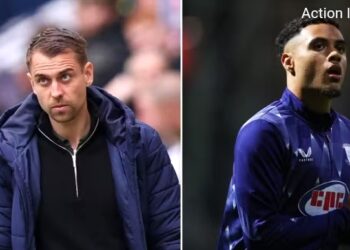
A former Premier League footballer who once earned vast sums during his playing days has now been officially declared bankrupt, highlighting the harsh and often overlooked reality many players face after retirement. While professional football can appear glamorous and financially secure from the outside, the period following a player’s exit from the game is frequently uncertain, with numerous ex-stars struggling to manage life beyond football.
In recent years, at least eight former England internationals have been publicly linked to bankruptcy cases, underlining how difficult it can be for players to transition into successful second careers. One particularly sobering example involves a celebrated Scottish international whose financial troubles have escalated to debts exceeding £2.5 million, serving as a stark reminder of how quickly fortunes can change after the final whistle.
James McFadden, a former Everton and Birmingham City striker and a respected figure in Scottish football, has now become the latest high-profile name to encounter severe financial hardship. Despite continuing to work as a television pundit—most recently appearing on Sky Sports during Rangers’ 2–0 victory over Aberdeen in the Scottish Premiership—McFadden has been unable to avoid insolvency.
Bankruptcy Confirmed Amid Mounting Debts
At 42 years old, McFadden filed for bankruptcy after his liabilities climbed to £2,594,192, according to reports. He was declared insolvent after failing to resolve substantial tax obligations, nearly seven years after narrowly escaping a similar outcome. His situation mirrors those of other former footballers, including ex-Scotland captain Barry Ferguson and TV analyst Chris Sutton, who also faced financial turmoil after investing in UK film production ventures during their playing careers.
These schemes were initially promoted as tax-efficient investment opportunities, offering players financial incentives to participate. However, HM Revenue and Customs later determined that several of these arrangements amounted to tax avoidance, resulting in significant retrospective tax demands. As a result, insolvency specialist Paul Dounis of Opus Restructuring in Edinburgh has been appointed as trustee to oversee the recovery of funds owed to McFadden’s creditors.
The former Scotland international, who earned 48 caps for his country, has stated that he currently owns no assets that can be used to offset his debts. His bankruptcy was approved last month by the Accountant in Bankruptcy, Scotland’s national insolvency authority. Official documents list his current occupation as a football commentator and reference a company called Sports and Media Consultancy Limited. The business is run solely by his wife, Gillian, and its most recent financial filings show available funds of £25,796.
Official Statement Released
Confirming the development, a spokesperson for Opus Restructuring explained that McFadden had voluntarily entered sequestration in Scotland. The statement attributed his financial collapse to losses arising from property and film investment schemes dating back to the early 2000s, alongside unresolved tax issues. The spokesperson emphasized that all legal and regulatory procedures are being handled appropriately.
McFadden’s difficulties with tax authorities are not new. In 2018, he was taken to court by HMRC over an outstanding tax bill and was forced to rely on financial assistance from a family member to resolve the issue at the time. Now, as 2026 begins, he once again finds himself facing serious financial consequences.
This downturn contrasts sharply with the wealth he accumulated during his Premier League career, where he is believed to have earned tens of thousands of pounds, and with the recognition he has enjoyed as a broadcaster. His media work even produced a memorable moment during Scotland’s recent World Cup qualification campaign.
On the pitch, McFadden remains a cherished figure among Scottish supporters, particularly for his unforgettable goals. His legendary 30-yard, left-footed strike against France in Paris in 2007—securing a famous 1–0 victory in a Euro 2008 qualifier—cemented his status as a Tartan Army hero. Yet despite those iconic, money-spinning moments in football, his personal financial journey in recent years has been far less forgiving.