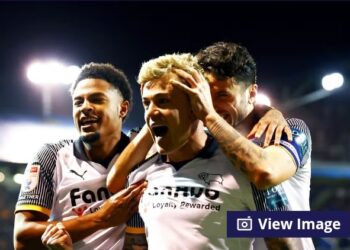
Derby County and their manager John Eustace have plenty of reasons to feel grateful that Celtic were unable to complete a move for Bobby Clark earlier in the season.
When reflecting on this campaign, it’s difficult to find many teams who have exceeded expectations as convincingly as Derby County. Coming into the season, most observers viewed the Rams as outsiders for a potential play-off push at best. This cautious optimism was largely based on Eustace’s solid track record from previous roles at clubs like Birmingham City and Blackburn Rovers.
However, Derby’s primary objective at the beginning of the campaign was far more modest. After narrowly avoiding relegation in their first season back in the Championship (2024/25), the club’s main aim was to stabilise and establish themselves as a consistent presence in the division. Not only have they achieved that, but they have also gone beyond expectations, entering the final stretch of the season with a realistic—if slim—chance of finishing in the top six and securing a play-off spot.
A significant factor behind this success has been the recruitment strategy overseen by Eustace. Over the course of the season, the club brought in 17 new players, many of whom had previously worked with the manager. Familiar names such as Dion Sanderson, Lewis Travis, and Sammie Szmodics highlight the influence Eustace had in shaping the squad to suit his system and philosophy.
Interestingly, one of the standout performers this season is a player Eustace had no prior working relationship with—Bobby Clark. The young midfielder joined on loan from RB Salzburg, just a year after making a high-profile £10 million transfer from Liverpool. Since arriving at Pride Park, Clark has quickly become an essential part of the team, regularly featuring in the starting lineup.
That said, his impact at Derby almost came to an abrupt end midway through the season. The club endured a difficult start under Eustace, winning just once in their opening 10 matches as the manager experimented with his new-look squad. During that period, Clark started only five games. However, once he found his footing, he became a mainstay in the team, starting 20 consecutive Championship matches between October and mid-February.
Clark’s versatility has been one of his biggest strengths. While primarily deployed as a defensive midfielder, he has also been effective in more advanced roles and even filled in on the wing when needed. His consistent performances showcased the potential that convinced Salzburg to invest heavily in him at such a young age.
Naturally, his form attracted interest from top-flight clubs during the January transfer window. Among the most serious suitors was Celtic, who were reportedly close to securing his permanent transfer. Had that deal gone through, Derby would have lost one of their most influential players at a crucial stage of the season.
Fortunately for Derby, the move never materialised, allowing Clark to remain at the club. He has continued to deliver strong performances, contributing three goals and three assists so far. His efforts have not gone unnoticed, earning him a nomination for the Championship Young Player of the Season award.
However, concerns have recently emerged regarding his fitness. Shortly after receiving that nomination, Clark was forced off just nine minutes into Derby’s 2-1 defeat to Southampton due to a hamstring injury. The timing could hardly be worse, as the team continues its push for a play-off place. Eustace admitted after the match that the severity of the injury was still unclear, leaving supporters anxiously awaiting updates.
If the injury proves to be serious and sidelines him for the remainder of the campaign, attention will quickly shift to the summer transfer window. Derby may explore the possibility of bringing Clark back, either on another loan deal or through a permanent transfer. However, given his impressive performances and the level of interest he has already attracted, the competition for his signature is likely to be intense, with clubs in stronger positions potentially outbidding Derby.
That said, Derby and Eustace have already demonstrated their ability to attract and retain players who fit their vision. There remains a possibility that Clark, having thrived under Eustace’s system, could be tempted to return to Pride Park if the opportunity arises.
Regardless of what happens next, Derby can take comfort in knowing that they were able to benefit from Clark’s contributions for as long as they did. Had Celtic succeeded in signing him in January, his influence on Derby’s season might have been cut short. Instead, both the manager and the fans can appreciate the role he has played in what has been a highly encouraging campaign.